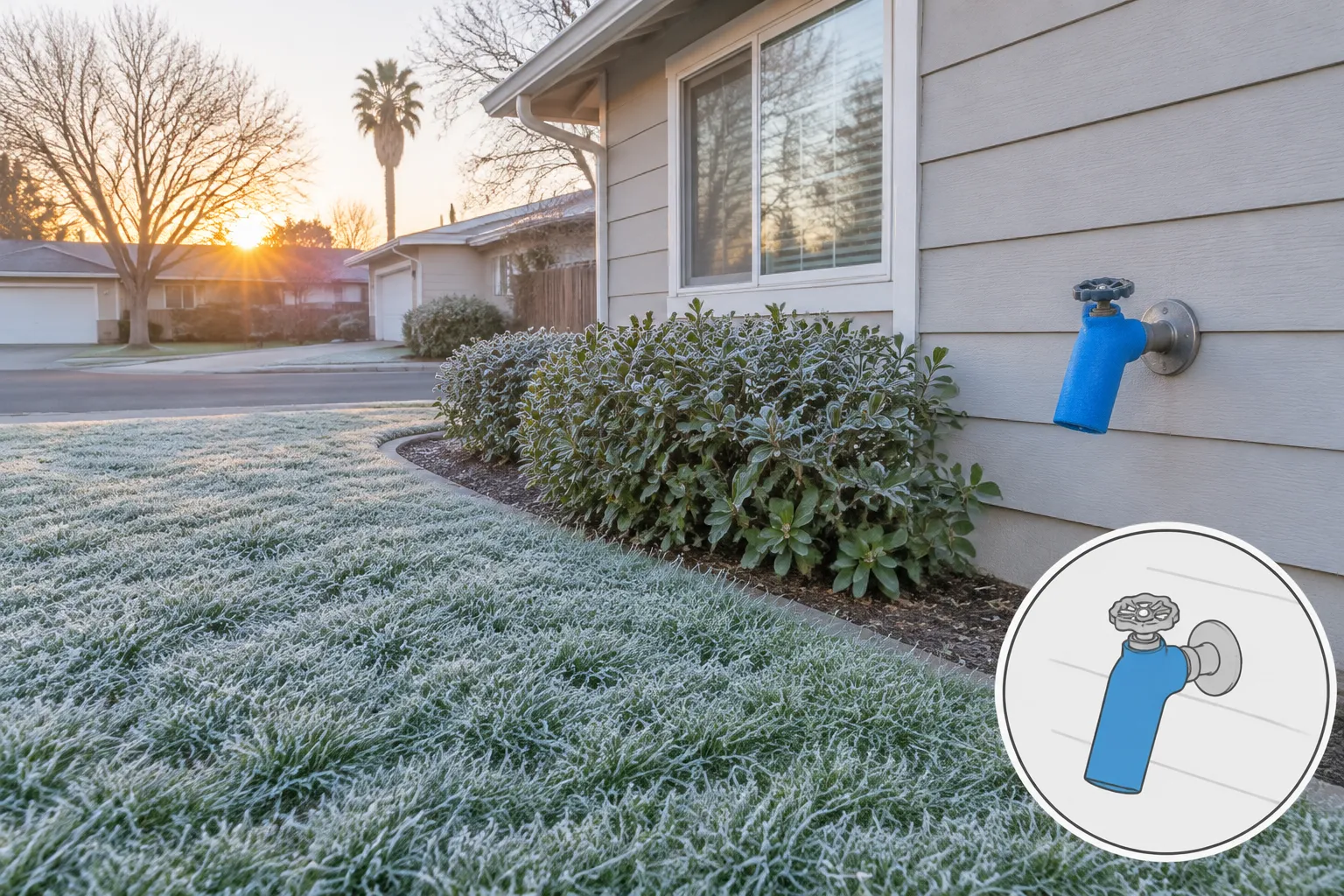
Frozen pipes are uncommon in Sacramento. The valley has hot, dry summers and mild winters, and most years bring only a handful of nights near or below 32 degrees Fahrenheit. When it does happen, the pipes at risk are in unheated crawl spaces, attics, garages, exterior walls and outdoor runs. If yours is frozen, a local plumber can thaw it and check for splits. The sections below say when to worry and when not to.
How often do pipes actually freeze in Sacramento?
Not often. National Weather Service climate records for Sacramento show that nights at or below 32 degrees Fahrenheit are a few per year in recent decades, mostly in December and January, and some years have almost none. Hard freezes, around 28 degrees or lower, are rarer still. A freeze that lasts long enough to freeze the water inside a pipe is rarer than a single cold night.
That matters for how you spend money. A homeowner in Minnesota insulates against months of deep cold. In Sacramento the risk is an occasional event, and it lands on a few weak spots rather than the whole house. A single night at 30 degrees does not usually freeze water in a pipe that sits in a heated room. Water has to lose enough heat for long enough, and that takes either a longer cold spell or a pipe with no protection from wind and cold air.
Because the event is unusual, people are often caught off guard. Few owners wrap or drain anything, and many homes have vented crawl spaces, garages and outdoor lines. A rare cold snap, such as a clear night after a winter storm, can freeze exactly those parts.
Where can pipes freeze in a Sacramento home?
In an unheated crawl space, an attic, a garage, an exterior wall without insulation, or any pipe outdoors. Hose bibs, irrigation backflow assemblies, pool and spa equipment lines, and water heater supply lines in a garage closet are the usual victims. Pipes in a vacant or unheated house, or under a mobile home, are also more exposed.
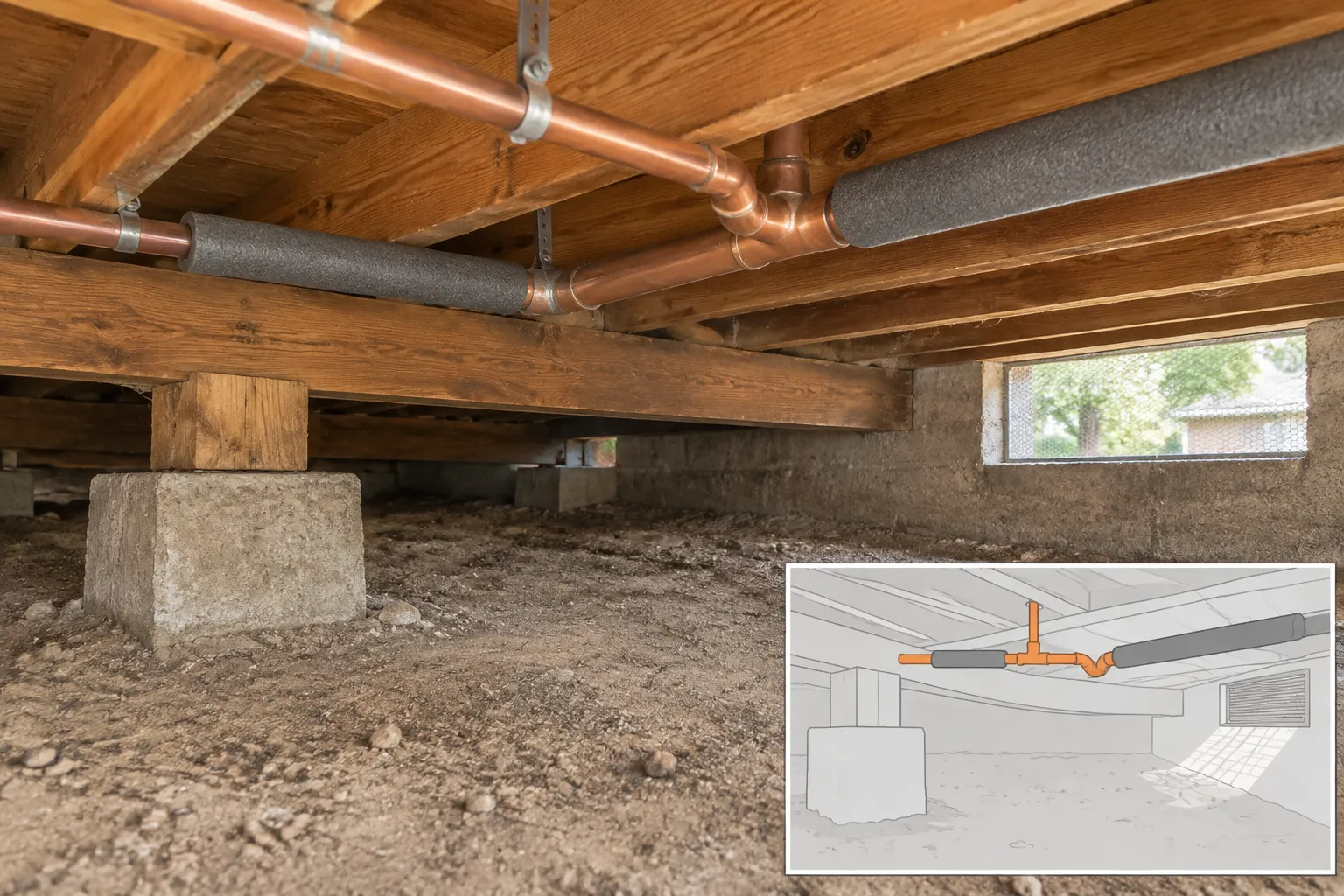
A short list of the most common weak spots:
- Hose bibs and irrigation lines. Outdoor faucets with a hose attached hold water in the line. Backflow preventers on sprinkler systems stick up above ground and have no cover.
- Crawl space plumbing. Many older Sacramento homes sit on raised foundations with vented crawl spaces. Pipes hung low in these spaces can be exposed to winter air coming through the vents.
- Garage and exterior wall plumbing. Washing machine boxes, water heaters in garage closets and kitchen sinks on an outside wall.
- Mobile and manufactured homes. Water lines below the floor can freeze if skirting is missing or heat tape fails.
- Vacant houses and rentals. Heat is off, nobody notices a split until water runs.
Pipes in a heated room or an interior wall rarely freeze here. If you are worried, how to tell is covered in how do you know if your pipes are frozen.
How do you prevent frozen pipes in a mild climate?
Protect only the weak spots. Cover outdoor faucets, wrap exposed pipes in foam sleeves, seal gaps around vents and pipe penetrations, and disconnect hoses. On a forecast of a hard freeze, let a faucet drip, open cabinet doors to a sink on an outside wall and keep the house heated, even if you are away. Shut off and drain irrigation if the forecast is severe.
Practical steps that fit Sacramento:
- Pick up foam pipe insulation and hose bib covers before winter. They cost a few dollars each and take minutes to fit.
- Disconnect garden hoses by November. A hose left on traps water in the faucet.
- Close or cover crawl space vents on the night of a hard freeze, and open them again afterward so moisture does not build up.
- Let one faucet farthest from the main drip slowly when the forecast says 28 degrees or lower. Moving water is harder to freeze.
- Keep the thermostat on when you travel in winter. A plumber or neighbor can check the house.
- Know where your main shutoff is. If a pipe does split, the damage is limited by how fast you shut the water off.
A cheap water sensor with leak alerts, placed in a crawl space or garage closet, can save a floor from a slow split that you would otherwise not see for days. Do not wait for a stain on the ceiling to find out. Leak Detection gear is simple now, and a sensor costs far less than a repair.
Pipe material affects risk too. Flexible plastic such as PEX tolerates freezing better than copper because it can expand a little, though it is not freeze-proof. The PEX versus copper comparison covers that trade-off.
Who do you call for frozen pipes?
Call a local plumber. If water is running from a split, shut off the main valve first, then call. If a pipe is frozen but not leaking, you may be able to thaw it yourself with gentle heat, and the how-to guide for thawing frozen pipes explains how. Call a plumber if you cannot reach the frozen section, if you see a bulge or crack, or if water appears after thawing.
An emergency visit works the same as any urgent plumbing call, and the plumber emergency page covers what to expect. For a split pipe that is already spraying water, see burst pipe plumber. That page explains that a frozen pipe does not always burst, which is why a careful thaw is often worth trying first.
When you call, say where the pipe is, whether any water is coming out of any faucet, whether you can see a split and where the main shutoff is. A plumber can often judge the job from that.
What does a frozen pipe repair cost in Sacramento?
A thaw alone, if the pipe has not split, is usually a short visit and costs less than a repair. If the pipe has split, Fixr's burst pipe repair guide puts the repair at $200 to $1,000, with water damage cleanup extra. The price depends on access, pipe material, whether a wall must be opened and what time you call. The plumber quotes the real price.
| Situation | Typical range | What drives it |
|---|---|---|
| Thawing an exposed pipe, no split | A short service call, which Fixr's plumber guide prices at $50 to $300 for the call fee | Access, equipment, call-out fee |
| Repairing one split section | $200 to $1,000 (Fixr) | Pipe size and material, wall access |
| Replacing a damaged run | Higher, depends on length | Length of pipe, number of fittings |
| Water damage drying and repair | Water damage repair averages $1,200 to $5,000 (Fixr) | Wet area, materials removed |
Hourly rates are covered in how much a plumber costs per hour. If water is somewhere you cannot see it, leak detection cost explains what finding it involves.
Does home insurance cover frozen pipes?
Often yes for sudden damage, such as a pipe that freezes and bursts, though policies differ and many exclude damage from neglect or from a vacant home. They may pay for the water damage but not for the pipe itself. Read your policy or call your insurer, take dated photos and keep receipts. The California Department of Insurance publishes consumer guidance on claims.
Insurers sometimes ask whether you kept the house heated and took reasonable steps to prevent a freeze. That is one more reason to keep the thermostat on when you are away in a cold snap.
Questions people ask
What temperature do pipes freeze at?
Water freezes at 32 degrees Fahrenheit, but pipes inside walls and crawl spaces take longer to reach that than the air does. Exposed pipes in wind can freeze after several hours at or below the mid-twenties, and sheltered ones need longer. Insulated or interior pipes usually survive a short cold night. Watch the forecast for several hours below 28 degrees.
Will a frozen pipe thaw by itself?
Often yes, once temperatures rise, and in Sacramento that is usually within a day. The risk is that a pipe has split and you only find out when the ice melts. Keep the main shutoff ready, open the faucet so water can move and check for leaks as it thaws.
How long does a frozen pipe plumber visit take?
A thaw and check usually takes an hour or two. A repair of a split section adds more, and a pipe inside a wall adds time to open and patch it. Leave extra time if the plumber must find where the ice sits first.
What should I ask before I hire someone for a frozen pipe?
Ask for their California license number and check it with the Contractors State License Board. Ask whether the price is fixed or hourly, whether there is an after-hours fee, how they will thaw the pipe, and whether a permit applies to any repair. Ask who handles patching if a wall is opened.
Do I need to be home for a frozen pipe visit?
Someone should be there at the start to show the plumber the shutoff valve and the affected pipe. After that you can usually leave if the plumber can reach the work area and you agree how to stay in touch. In a vacant property, arrange access and photo updates in advance.
For other plumbing topics in the area, the Sacramento plumbing guide home page lists the full set of guides.
Read on
- Burst pipe repair
A burst pipe in Sacramento is rarely from freezing.
- Leak detection cost
Leak detection and leak repair costs in Sacramento: finding a hidden leak, slab leak repair, pipe repair prices and what to check before…
Sources used
Last changed