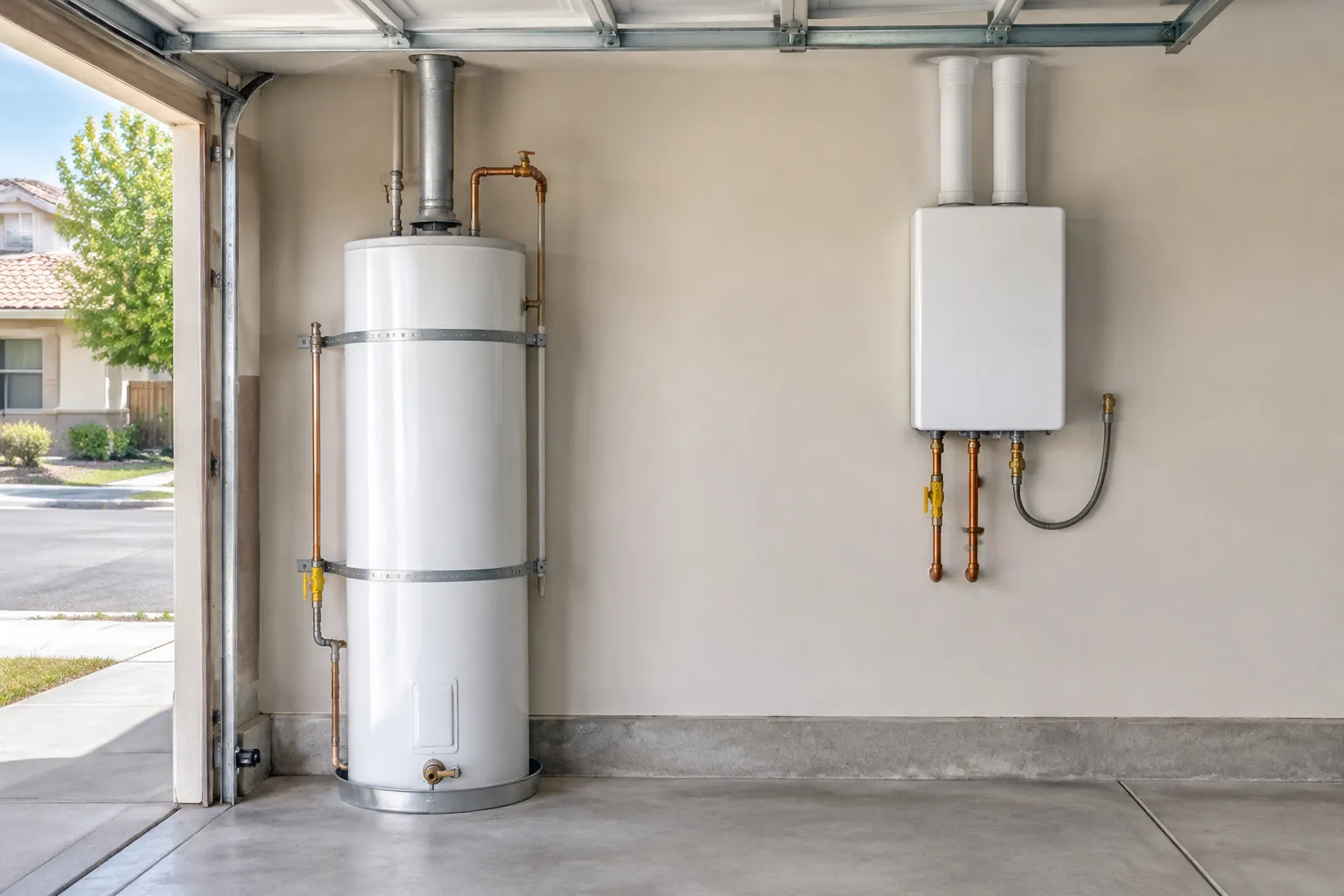
A tank water heater is the cheaper, simpler choice: This Old House's 2026 water heater cost guide lists $1,200 to $2,300 installed. The same guide puts a tankless water heater at $2,100 to $4,000 installed, with an average of about $2,800, but a tankless unit wastes less heat and tends to last longer. If your household is small and your gas line and vent are already close to right, tankless can pay off. If not, a tank is usually the better value. Sacramento prices vary.
This page is a companion to our guide to tankless water heater installation, which covers the install work itself. Here the aim is to compare the two types side by side, show the cost math and flag the code points that apply when you replace a tank.
What is the difference between a tank and a tankless water heater?
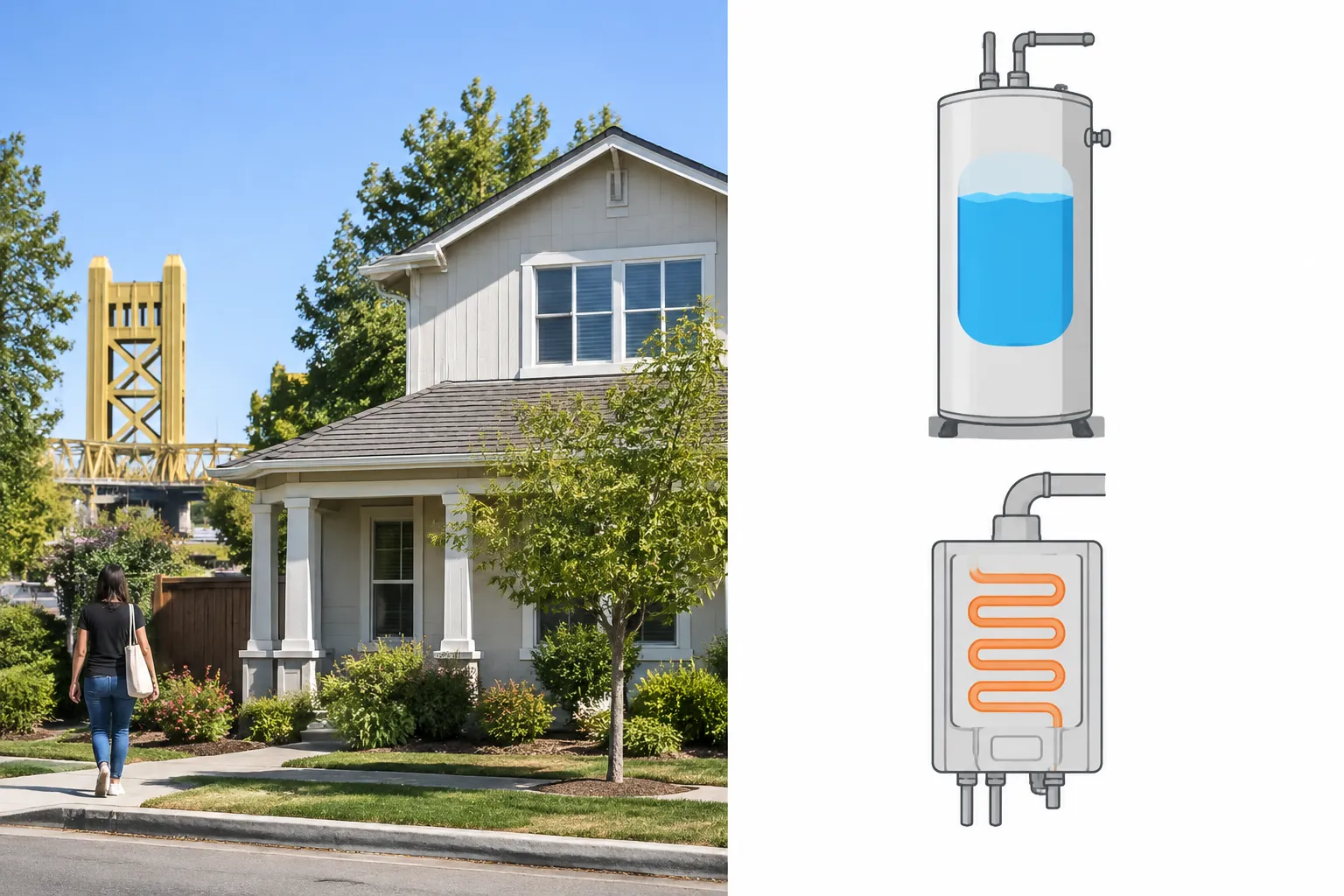
A tank heater keeps 30 to 80 gallons of water hot all day and refills when you use it. A tankless heater heats water only when a tap opens, passing it through a gas burner or electric element. The tank has a limited supply and standby heat loss. The tankless has no storage, so its limit is how many gallons per minute it can heat.
| Feature | Tank | Tankless | |
|---|---|---|---|
| Installed cost | $1,200 to $2,300 | $2,100 to $4,000 (This Old House) | $2,500 to $6,500, up to $8,000+ if the home needs new gas line, vent or circuits |
| Hot water supply | Runs out after the tank empties | Continuous, limited by flow rate | |
| Energy use | Standby losses | For gas models, the U.S. Department of Energy puts savings at 24% to 34% in low-use homes and 8% to 14% in high-use homes | |
| Typical life | 10 to 15 years | Up to 20 years with maintenance | |
| Space | A floor footprint of a few square feet | Wall mounted, small | |
| Maintenance | Flush, check the anode rod | Yearly descaling |
What affects the price of tank vs tankless?
The unit is only part of the bill. A like-for-like tank swap reuses the existing gas line, vent and water lines. Moving to tankless usually adds a larger gas pipe, a new vent, valves and sometimes a condensate drain or a higher-amperage circuit. Permit fees, haul-away of the old tank and any code upgrades apply to both.
Price drivers to ask about:
- Fuel: gas, electric, heat pump or propane. See electric vs gas water heaters.
- Size: 40 gallon, 50 gallon or a larger flow rate for tankless.
- Location: garage, closet, attic or exterior wall.
- Venting and gas line changes, covered in gas line installation cost.
- Permit: the City of Sacramento lists fees for water heater replacement.
For total cost lines, see water heater replacement cost and tankless water heater cost.
Is tankless worth it? A simple payback check
Compare the extra upfront cost with the yearly savings. Using This Old House's averages of about $2,800 for tankless and $1,950 for a tank, say a tankless gas unit costs about $850 more than a tank, and your tank's water heating costs about $250 a year in gas. A 25% saving is about $60 a year, which gives a payback of about 14 years. Savings are larger in big households, but then the tankless unit may also need to be larger.
That example is illustrative, not a prediction. Run it with your own gas bill. The longer lifespan of tankless, which the Department of Energy puts at up to 20 years against 10 to 15 for a tank, narrows the gap, because you may buy a tank twice in the time one tankless unit lasts. Another benefit is not running out of hot water in a long shower. Many people choose tankless for that reason, not for savings.
Signs you should consider tankless instead of another tank
A switch makes sense when the tank is near the end of its life and one of these is true: you want to free floor space, you run out of hot water in your household and a bigger tank will not fit, you are already updating the gas line, or you plan to stay in the house for 15 years or more. It makes less sense if the gas line and vent would need major rework.
The benefits of tankless matter most when the importance of space and a steady supply outweighs the higher price. Technicians can work out the connections and venting you would need. Check these before deciding:
- Age and condition of your current tank. See how long a water heater lasts.
- Your peak hot water use, such as how many showers run at once.
- Water hardness at your address, since scale hurts tankless heat exchangers faster.
- Whether the house has a closed water system, which affects the expansion tank.
If you only have a leak and a failing tank, emergency water heater repair may be the first step, but a rushed replacement is not the best time to choose between types if you can wait a day or two with temporary hot water arrangements.
How do you replace a tank water heater with a tankless one?
Installing a tankless unit in place of a tank means the plumber removes the old tank, caps or reuses the lines, mounts the tankless unit, upgrades the gas pipe and vent if needed, connects water with service valves and tests. The plumbing code may still call for an expansion tank if the home has a closed water system, even with no storage tank. The job usually takes a day.
Because the unit mounts on a wall, the plumber may move it from the garage floor spot. A permit is expected. Our guide to choosing a plumber for water heater replacement lists what to ask. Mini tank units, which are small 2.5 to 6 gallon heaters, are a third option, but they serve a single sink or a short run and do not replace a whole-house heater.
What does the California plumbing code say about expansion tanks?
When the cold water supply has a check valve, backflow preventer or pressure reducing valve, the system is closed and heated water has nowhere to expand. The plumbing code addresses this with a thermal expansion tank or similar device on the cold supply near the heater. Your plumber confirms what applies to your house and the local inspector checks it.
An expansion tank is a small pressurized tank, and its internal diaphragm wears. A common rule of thumb is to check it every few years and expect a service life of roughly 5 to 10 years, but treat that as an estimate, not a rule. A waterlogged tank causes a dripping relief valve. See relief valve replacement if that is your symptom. Fixr's 40-gallon water heater guide lists an expansion tank at $150 to $400.
What about propane, 2016 comparisons and other variations?
On propane, the cost gap is similar, but tank running costs are higher because propane costs more per unit of heat than natural gas. Tankless propane units suit homes with an outside storage tank, not small cylinders. Older comparisons from 2016 are out of date on price, since equipment, labor and fuel costs have moved a lot since then.
Federal efficiency standards for tank heaters have tightened over time, which is why many large tank models now cost more and some use heat pump or condensing designs. In California, state energy rules and utility programs keep shifting, so check current rebates and rules before buying. For the home page of this guide and a map of other topics, start at the Sactown Plumbing Guide home page.
Questions people ask
How long does tank vs tankless water heater take?
A tank-for-tank replacement usually takes two to four hours. A switch from tank to tankless takes longer, often a full day, because of the gas line, vent and wall mounting. Inspection by the city can add a separate visit. Ask the plumber for a written timeline and whether hot water will be off overnight.
What should I ask before I hire someone for tank vs tankless water heater?
Ask how they sized the tankless unit, what the quote includes for gas line, vent, permit, straps and disposal, and what warranty covers parts and labor. Ask for a written quote for both a tank and a tankless option so you can compare. Check their license number with the California Contractors State License Board.
Do I need to be home for tank vs tankless water heater?
Plan to be home for the start, to give access and approve the price, and at the end to see the unit tested and learn the shutoff valves. Hot water is off for part of the day. If you cannot be there, an adult you trust can stand in once the written price is agreed.
Sources used
Last changed