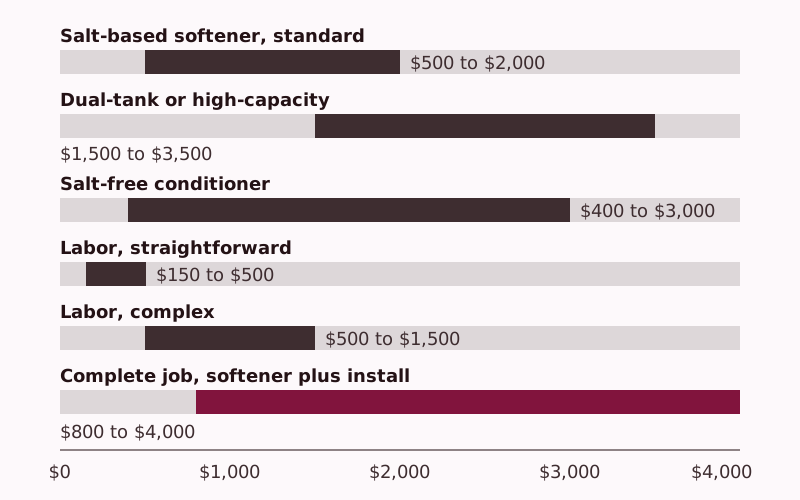
Fixr's water softener installation guide (updated January 2025) puts the national cost at $1,100 to $3,000 installed, with an average of $2,500, and says installation labor ranges from $150 to $1,000. A basic salt-based unit on an easy install sits near the bottom of that range. A larger whole-house system, a long pipe run or extra work like a new drain and outlet pushes toward the top. Sacramento prices vary, and the specialist you hire quotes the real one.
Before you spend on a softener, make sure you need one. The page on water softeners and hard water explains what hard water does and how to test it. This page covers what the job costs and what changes the price. You can get quotes from local specialists on the quote page.
How much does water softener installation cost?
Fixr lists installation labor at $150 to $1,000 and an installed single-tank system at $650 to $1,500, with dual-tank systems at $1,500 to $3,000. Where the job falls depends on the unit size, how far the softener sits from the main water line and whether a drain and a power outlet are close by.
| Item | Typical range |
|---|---|
| Salt-based softener, standard household | $650 to $1,500 installed, single tank (Fixr) |
| Dual-tank or high-capacity softener | $1,500 to $3,000 installed (Fixr) |
| Salt-free conditioner (descaler) | $350 to $2,450 installed (Fixr) |
| Installation labor, straightforward | $150 to $1,000 (Fixr) |
| Complete job, softener plus install | $1,100 to $3,000, average $2,500 (Fixr) |
These come from Fixr's water softener installation guide (updated January 2025). National brands such as Kinetico and Culligan sell through their own dealers, often bundling equipment and installation in one quote. A plumber may install a unit you buy at a retailer, but ask whether that affects the warranty.
What is the cost of a water softener loop installation?
A water softener loop, the set of pipes and valves that lets the softener tie into your water line near where it enters the house, costs $600 to $2,000 when none exists, according to Fixr. A softener loop is common in new construction and remodels. It lets the owner or a dealer drop in a softener later without cutting into the main plumbing.
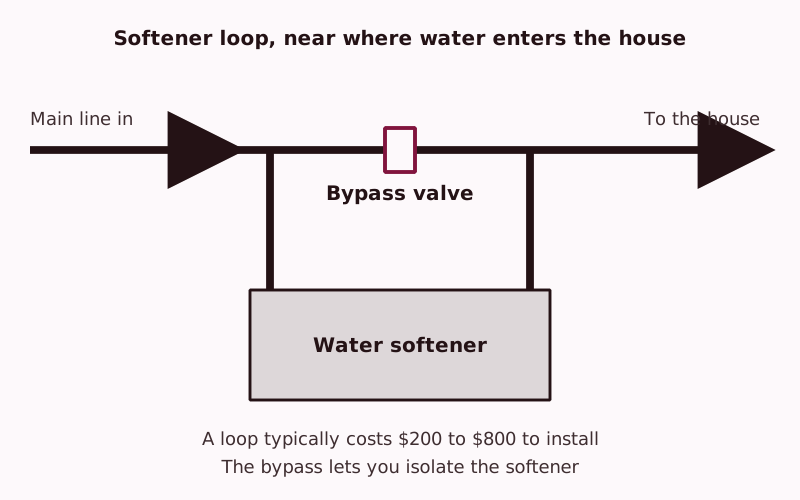
If your house does not have a loop, the plumber adds one when the softener goes in. That work includes cutting the main line, adding a bypass valve so you can isolate the softener, and connecting inlet and outlet lines. The loop is part of the labor cost in the table above, and it is where an experienced plumber earns their fee, since a poor connection can leak or restrict flow.
Water softener loop installation costs rise when the main line is in a finished wall, under a slab or far from the garage or utility area where the softener sits. They also rise when the pipe is an older material that does not take new fittings easily. For related work like a main line replacement, see the repiping cost page.
How much does a salt-free system cost compared with a salt-based softener?
A salt-free conditioner (descaler) is $350 to $2,450 installed in Fixr's guide, against $650 to $3,000 for an ion exchange softener. Salt-based softeners remove hardness minerals by ion exchange. Salt-free systems do not remove hardness. They change how minerals behave so they scale less, which is a different result.
The choice depends on what you want. If you want soft water for soap, skin and spotless dishes, a salt-based softener does that. If you only want to reduce scale in pipes and appliances without adding salt or a drain line, a conditioner may be enough. Results vary by product, and salt-free systems do not lower the measured hardness of the water.
Check local rules too. Some California communities restrict or ban salt-based softeners that discharge brine into the sewer, to protect water recycling. This page could not confirm a rule for the City of Sacramento, so ask the plumber and your water or sewer provider before you buy.
Do I need a water softener in Sacramento?
Not always. Hardness varies across Sacramento depending on whether your water comes from surface water, such as the rivers, or from groundwater wells. Water from rivers tends to be softer than groundwater. You can check the hardness of your own water in the annual water quality report from your water provider, or with a test kit.
Signs of hard water are white scale on faucets and showerheads, spots on glasses, soap that does not lather well and scale buildup in water heaters and kettles. Scale shortens appliance life and cuts water heater efficiency. If you do not see these signs and your water report shows soft water, a softener adds cost with little benefit.
Test your water before you buy. Be careful with in-home sales visits that present a very high reading from a demonstration test. Ask for the number in grains per gallon or milligrams per liter, and compare it with your utility's report. Grains per gallon and milligrams per liter are two scales for the same thing.
What pushes the price of a water softener installation up or down?
Six things matter: the size of the unit, the brand, the distance to your water line, whether a drain and a power outlet are nearby, the material of your pipes and any code upgrades. A unit in a garage next to the main shutoff is a quick job. A unit in a finished basement or on the opposite side of the house is not.
- Unit capacity. Bigger households and harder water need larger tanks, which cost more.
- Brand and features. Metered valves, Wi-Fi monitoring and dual tanks raise the price.
- Plumbing access. Finished walls and long runs add labor.
- Drain. A softener needs a place to discharge its regeneration water. If there is no standpipe or floor drain nearby, one must be added.
- Electrical. Most softeners need an outlet. If none is nearby, an electrician may need to add one, which is separate work.
- Pipe material. Copper, PEX, CPVC and galvanized pipes each need different fittings. Older galvanized lines can be a problem.
- Permit. Some jobs need none. Ask the plumber whether yours does.
Also ask about ongoing costs: salt is typically a few dollars a bag and a household may use one bag a month or two, though it depends on hardness and use. Yearly service is optional on most units.
How do you compare water softener quotes?
Compare quotes on the same terms: the equipment model and capacity, the installation scope, the drain and electrical work, the warranty and the total. A low quote that excludes the loop, the drain or the bypass is not low. Ask each company to name the brand and model so you can look it up.
Be cautious of financing offers and "limited-time" prices from in-home presentations. A fair quote is available in writing and does not expire at the end of a visit. Check the contractor's license number on the state board's website when the job is $1,000 or more, since California requires a contractor with the right California license at that threshold under Contractors State License Board rules. You can start by collecting offers on the quote page. For general rates, see the plumber hourly rate guide. The Sactown Plumbing Guide home page lists other topics.
Questions people ask
How long does water softener installation take?
Most installs take two to four hours when the softener is placed near the main line with a drain and an outlet close by. A job that needs a new loop, a drain line or electrical work can take most of a day. Water is off for part of that time, so plan around laundry and showers.
What should I ask before I hire someone to install a water softener?
Ask for the brand, model and capacity, the full installation scope, whether a loop, drain and bypass are included, who handles any electrical work and what the warranty covers. Ask for the total in writing, and for the contractor's license number to check on the state board's website.
Do I need to be home for water softener installation?
Yes, an adult should be there at the start to confirm where the unit goes and at the end to see it set up and learn how to add salt and use the bypass. The plumber shuts off water briefly. Make sure the plumber can reach the main shutoff and the install area.
Can I install a water softener myself?
Many homeowners do, since softeners come with instructions and a bypass valve. It involves cutting into the water line, soldering or fitting pipe and connecting a drain, so mistakes can cause leaks. If you are not comfortable with plumbing, hire a plumber. Check any local brine discharge rules before you connect a salt-based unit.
Sources used
Last changed